What Are Headings in SEO: Types & Their Benefits?
What Are Headings in SEO: Types & Their Benefits?
H1, H2, H3 Headings
H1, H2, H3 Headings
H1, H2, H3 Headings
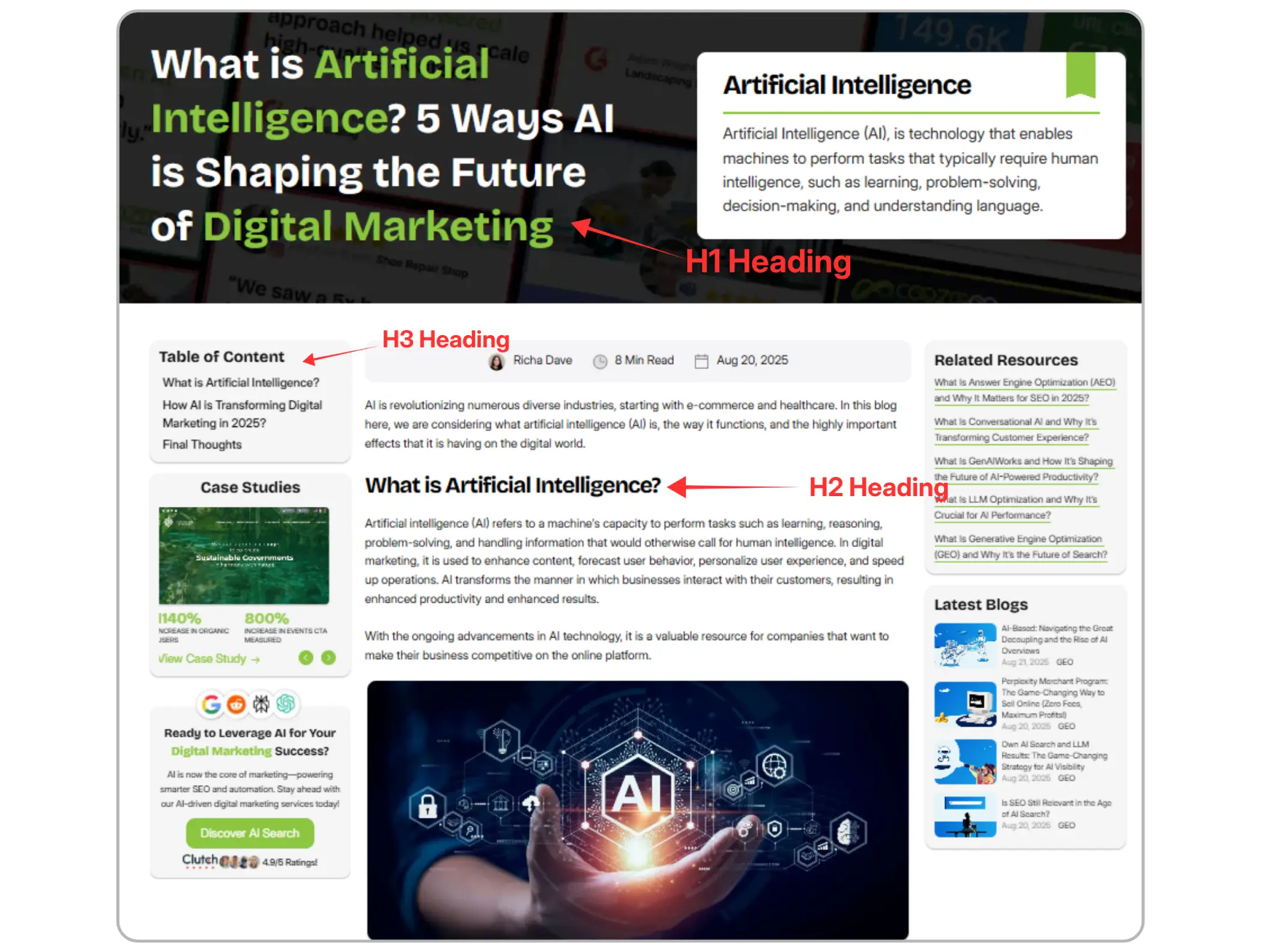
Headings H1, H2 and H3 are the HTML heading tags that define the order and importance of content on webpage. It helps both readers and crawlers, to easily understand and navigate.
Headings H1, H2 and H3 are the HTML heading tags that define the order and importance of content on webpage. It helps both readers and crawlers, to easily understand and navigate.

Table of Content


Structure Your Content with Headings That Rank and Convert







4.9/5 Ratings!

Anil Jangid
Anil Jangid
6 Min Read
6 Min
Sep 23, 2025
Sep 23, 2025
What are HTML Headings?
HTML (Hypertext Markup Language) headings are tags you use to set up text on your website. They show people what is important and what is not. This is like how a book uses chapters and sections. You use the H1 tag for the biggest text that matters most. You use the H6 tag for text that is not as big or important.
For most web pages and blog posts, you will use the first three the most.
HTML (Hypertext Markup Language) headings are tags you use to set up text on your website. They show people what is important and what is not. This is like how a book uses chapters and sections. You use the H1 tag for the biggest text that matters most. You use the H6 tag for text that is not as big or important.
For most web pages and blog posts, you will use the first three the most.
•
H1: The one big title at the top of your page. It gives the main idea of what the page is about.
H1: The one big title at the top of your page. It gives the main idea of what the page is about.
•
H2: Large headings that split your text into important sections. They help people see what each part is about.
H2: Large headings that split your text into important sections. They help people see what each part is about.
•
H3: Smaller headings that break down the topics inside each H2 section.
H3: Smaller headings that break down the topics inside each H2 section.
Your H1 works as the main headline. The H2s are like names of chapters. The H3s are small headings inside each chapter. Think of it as a way to help people read and find stuff quickly.
Your H1 works as the main headline. The H2s are like names of chapters. The H3s are small headings inside each chapter. Think of it as a way to help people read and find stuff quickly.
The Dual Power of Headings: Why They Matter?
Headings that are used in the right way help people read your site better. They also help search engines understand your pages. This makes the user experience good. It also helps with SEO.
Headings that are used in the right way help people read your site better. They also help search engines understand your pages. This makes the user experience good. It also helps with SEO.
Many people read things on the internet by quickly looking over text. They try to find things that will answer their questions. Headings help with this. They make it fast and easy for people to get what they need.
Many people read things on the internet by quickly looking over text. They try to find things that will answer their questions. Headings help with this. They make it fast and easy for people to get what they need.
•
Improved Readability: Headings split big text into smaller parts, so the words are easier for people to read.
Improved Readability: Headings split big text into smaller parts, so the words are easier for people to read.
•
Clear Navigation: They help people go through your article fast and pick the spot they want to read.
Clear Navigation: They help people go through your article fast and pick the spot they want to read.
•
Better Use for All: Screen readers read out headings to help people with low vision find their way around the page, making your site simple for them to use.
Better Use for All: Screen readers read out headings to help people with low vision find their way around the page, making your site simple for them to use.
For Search Engines (SEO)
Search engines use HTML headings to see the structure and main topics of the page. This helps them know what your page is about.
Search engines use HTML headings to see the structure and main topics of the page. This helps them know what your page is about.
•
•
Content Order: A clear order like H1, then H2, then H3 shows which parts matter more. It also lets people see how ideas fit together. When you do this, your page can be shown higher.
Content Order: A clear order like H1, then H2, then H3 shows which parts matter more. It also lets people see how ideas fit together. When you do this, your page can be shown higher.
•
Featured Snippets: If your titles and sections are clear, your content can be picked for Google’s top answer boxes.
Featured Snippets: If your titles and sections are clear, your content can be picked for Google’s top answer boxes.
How to Use H1, H2, and H3 Headings Correctly?
The H1 Tag: Your Main Title
Your H1 is the most important heading.
Your H1 is the most important heading.
•
Use just one H1 on each page. If you add more than one, search engines get confused.
Use just one H1 on each page. If you add more than one, search engines get confused.
•
Make the H1 clear and make it interesting so people want to read more.
Make the H1 clear and make it interesting so people want to read more.
•
Put your main keyword in the H1. This shows what the page is about.
Put your main keyword in the H1. This shows what the page is about.
H2 Tags: Main Subheadings
Use H2 tags for sections that help the main H1 topic.
Use H2 tags for sections that help the main H1 topic.
•
Split clear ideas into H2 headings. Make sure each heading talks about a main point.
Split clear ideas into H2 headings. Make sure each heading talks about a main point.
•
Keep the same format for all of the text so the article stays neat.
Keep the same format for all of the text so the article stays neat.
H3 Tags: Supporting Your Subheadings
H3 tags give extra detail to an H2 section.
H3 tags give extra detail to an H2 section.
•
Use them to help sort examples, lists, or steps for each H2.
Use them to help sort examples, lists, or steps for each H2.
•
Keep the headings in order. Do not jump from H1 to H3. A clear flow is good for both users and search engines.
Keep the headings in order. Do not jump from H1 to H3. A clear flow is good for both users and search engines.
Final Thoughts
Headings are not just text styles. They help people read your pages better and help your site with SEO, too. A good H1 tells what the page is about. You should use strong H2s for each big part, and H3s are good for smaller points. This makes the text easy to read and helps people know what comes next. It also shows search engines what your content is about. Just like using negative keywords in ads helps filter out irrelevant searches, using the right headings helps search engines and users find exactly what they’re looking for. Proper heading use can make your content stronger and help it rank higher in search results.
Headings are not just text styles. They help people read your pages better and help your site with SEO, too. A good H1 tells what the page is about. You should use strong H2s for each big part, and H3s are good for smaller points. This makes the text easy to read and helps people know what comes next. It also shows search engines what your content is about. Just like using negative keywords in ads helps filter out irrelevant searches, using the right headings helps search engines and users find exactly what they’re looking for. Proper heading use can make your content stronger and help it rank higher in search results.
Frequently Asked Questions (FAQs)
Frequently Asked Questions
How many H1 tags should a page contain?

Each page should ideally have only one H1 tag. Multiple H1s can confuse search engines about the page’s primary topic, potentially harming SEO rankings. The H1 should clearly represent the page’s main subject.
How do headings improve SEO rankings?
You should expect a structured process that includes onboarding, goal setting, strategy development, regular communication, execution of campaigns, and performance reporting. A good agency will act as a partner collaborating with you to understand your business, crafting a custom plan, and keeping you informed about progress and results.
Can keywords in headings impact SEO?
Vanity metrics are data points that look impressive but don’t directly impact your bottom line, such as social media likes, page views, or email open rates. While they can indicate visibility, they’re not strong indicators of business success. What’s more important are actionable metrics like lead quality, conversion rate, and return on investment (ROI). Looking for more details? Contact us today before your competitors do.
Are there risks of using too many headings?
High traffic without conversions often points to deeper issues such as: Poor targeting (the wrong audience is visiting), weak calls-to-action or unclear messaging, website usability issues or slow load times, lack of trust signals (like reviews or security).
Your marketing should not just drive visits; it should drive the right visitors and guide them to act.
Can headings support internal linking strategies?
You’ll know it’s working when you see measurable progress toward your business goals, more qualified leads, better engagement, increased sales, or stronger ROI. Regular reports, clear KPIs, and consistent communication from your agency are key to evaluating success.
What are HTML headings, and why are they critical for websites?
Organic marketing (like SEO, blogging, and social media engagement) often takes 3 to 6 months to start showing results and may take 6–12 months for significant impact. It builds trust and authority over time, and while slower than paid marketing, it often yields more sustainable growth.
What is the primary difference between H1, H2, and H3 tags?
A good marketing report should cover: Key performance indicators (KPIs) tied to your goals, traffic and conversion data, campaign performance summaries, ROI or cost-per-lead/acquisition, insights and recommendations for improvement, clear next steps or action items.
It should be easy to understand, jargon-free, and focus on outcomes. Learn more—how we drive revenue?
How many H1 tags should a page contain?
Each page should ideally have only one H1 tag. Multiple H1s can confuse search engines about the page’s primary topic, potentially harming SEO rankings. The H1 should clearly represent the page’s main subject.
How do headings improve SEO rankings?
You should expect a structured process that includes onboarding, goal setting, strategy development, regular communication, execution of campaigns, and performance reporting. A good agency will act as a partner collaborating with you to understand your business, crafting a custom plan, and keeping you informed about progress and results.
Can keywords in headings impact SEO?
Vanity metrics are data points that look impressive but don’t directly impact your bottom line, such as social media likes, page views, or email open rates. While they can indicate visibility, they’re not strong indicators of business success. What’s more important are actionable metrics like lead quality, conversion rate, and return on investment (ROI). Looking for more details? Contact us today before your competitors do.
Are there risks of using too many headings?
High traffic without conversions often points to deeper issues such as: Poor targeting (the wrong audience is visiting), weak calls-to-action or unclear messaging, website usability issues or slow load times, lack of trust signals (like reviews or security).
Your marketing should not just drive visits; it should drive the right visitors and guide them to act.
Can headings support internal linking strategies?
You’ll know it’s working when you see measurable progress toward your business goals, more qualified leads, better engagement, increased sales, or stronger ROI. Regular reports, clear KPIs, and consistent communication from your agency are key to evaluating success.
What are HTML headings, and why are they critical for websites?
Organic marketing (like SEO, blogging, and social media engagement) often takes 3 to 6 months to start showing results and may take 6–12 months for significant impact. It builds trust and authority over time, and while slower than paid marketing, it often yields more sustainable growth.
What is the primary difference between H1, H2, and H3 tags?
A good marketing report should cover: Key performance indicators (KPIs) tied to your goals, traffic and conversion data, campaign performance summaries, ROI or cost-per-lead/acquisition, insights and recommendations for improvement, clear next steps or action items.
It should be easy to understand, jargon-free, and focus on outcomes. Learn more—how we drive revenue?



Structure Your Content with Headings That Rank and Convert
Proper Headings Improve SEO and Readability for Users.
Structure Your Content with Headings That Rank and Convert
Structure your headings to guide users, boost readability, and help google to understand the flow.
Structure your headings to guide users, boost readability, and help google to understand the flow.
Use structured headings to guide users, enhance readability, & help search engines understand your content better.
4.9/5 Ratings!
4.9/5 Ratings!
Share this article

Related Resources





Don’t miss our revenue growth tips!
Don’t miss our revenue growth tips!
Get expert marketing tips—straight to your inbox, like thousands of happy clients.
Get expert marketing tips—straight to your inbox, like thousands of happy clients.
Latest Blogs



























Ready to speak with an expert?
Data-Driven Marketing Agency That Elevates ROI
1100+
Websites Designed & Optimized to Convert
$280M+
Client Revenue Driven & Growing Strong
Discover how to skyrocket
your revenue today!


Trusted by 1000+ Owners!
Ready to speak with an expert?
Data-Driven Marketing Agency That Elevates ROI
1100+
Websites Designed & Optimized to Convert
$280M+
Client Revenue Driven & Growing Strong
Discover how to skyrocket
your revenue today!
Trusted by 1000+ Owners!
Want to skyrocket revenue?
4.9/5 Ratings!
Ready to speak with an expert?
Data-Driven Marketing Agency That Elevates ROI
1100+
Websites Designed & Optimized to Convert
$280M+
Client Revenue Driven & Growing Strong
Want to skyrocket
revenue?
Trusted by 1000+ Owners!
Call
Meet