10 Most-Cited Domains Across ChatGPT, Perplexity, Gemini, AI Overviews, and Claude
10 Most-Cited Domains Across ChatGPT, Perplexity, Gemini, AI Overviews, and Claude
Last Updated:
Table of Content
Title
Case Studies





The way people search is undergoing a fundamental transformation. Traditional search engines are no longer the only gateway to information. Platforms like ChatGPT, Perplexity AI, Google Gemini, Google AI Overviews, and Claude are rapidly becoming primary interfaces for discovery, research, and decision-making.
Unlike traditional search engines that return a list of links, these AI systems synthesize answers. They don’t just show results—they decide which sources are credible enough to include in a response. This shift has introduced a new kind of competition: not just ranking on search engines, but being cited by AI.
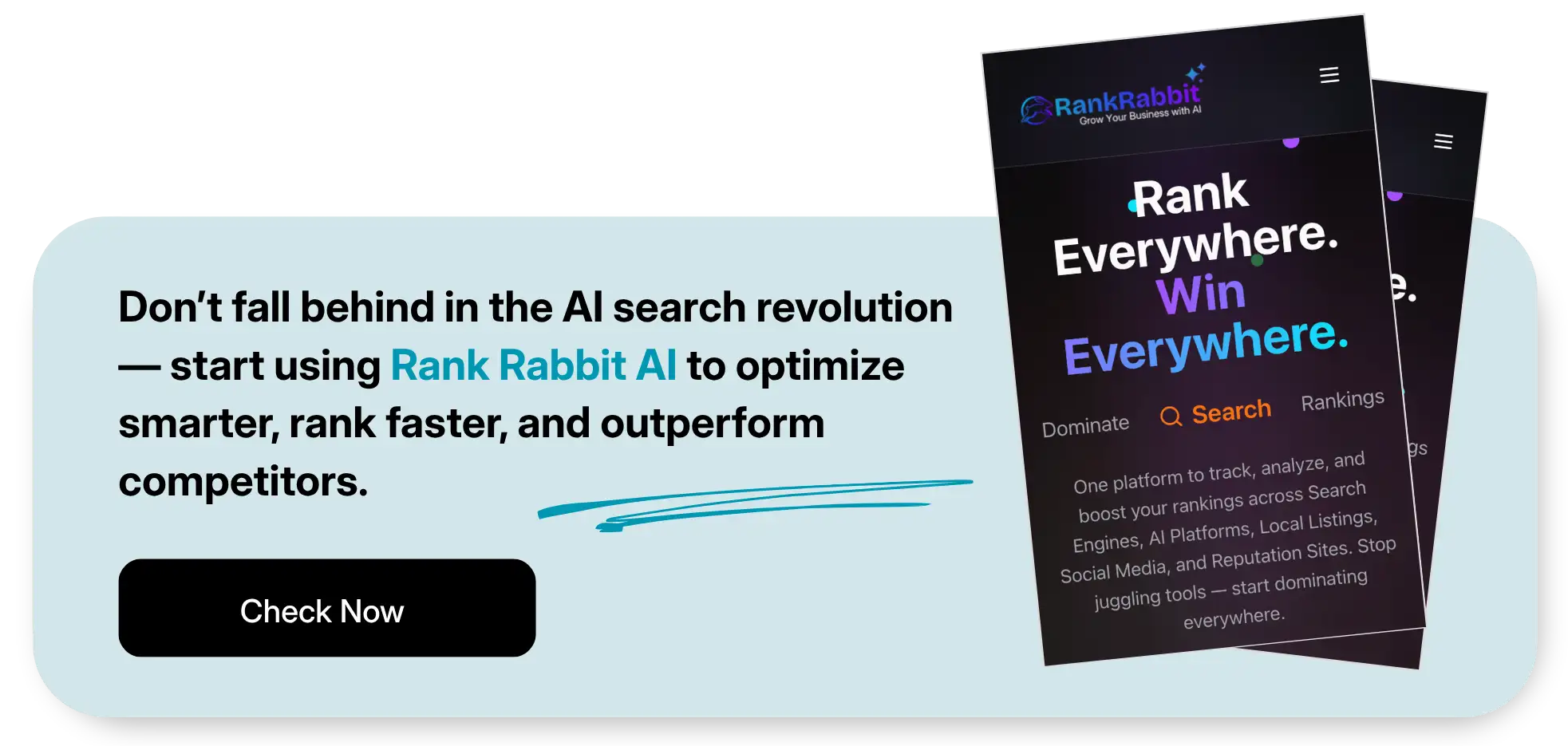
To understand what drives visibility in this new layer, we analyzed citation patterns using data from RankRabbit.
Understanding these patterns is critical because in the AI-driven ecosystem, visibility is no longer about being ranked—it’s about being referenced.
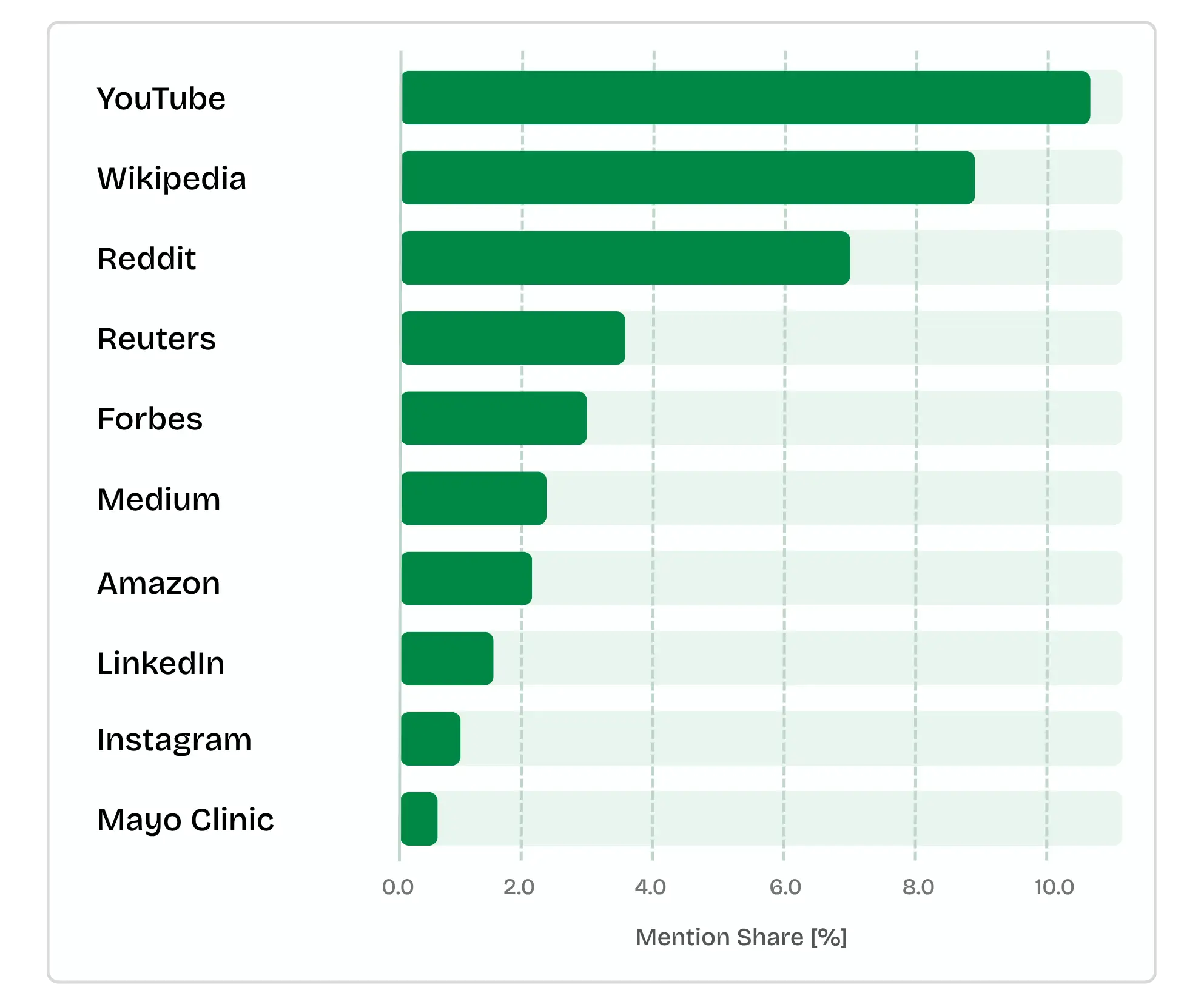
The 10 Most Cited Domains Across AI Assistants
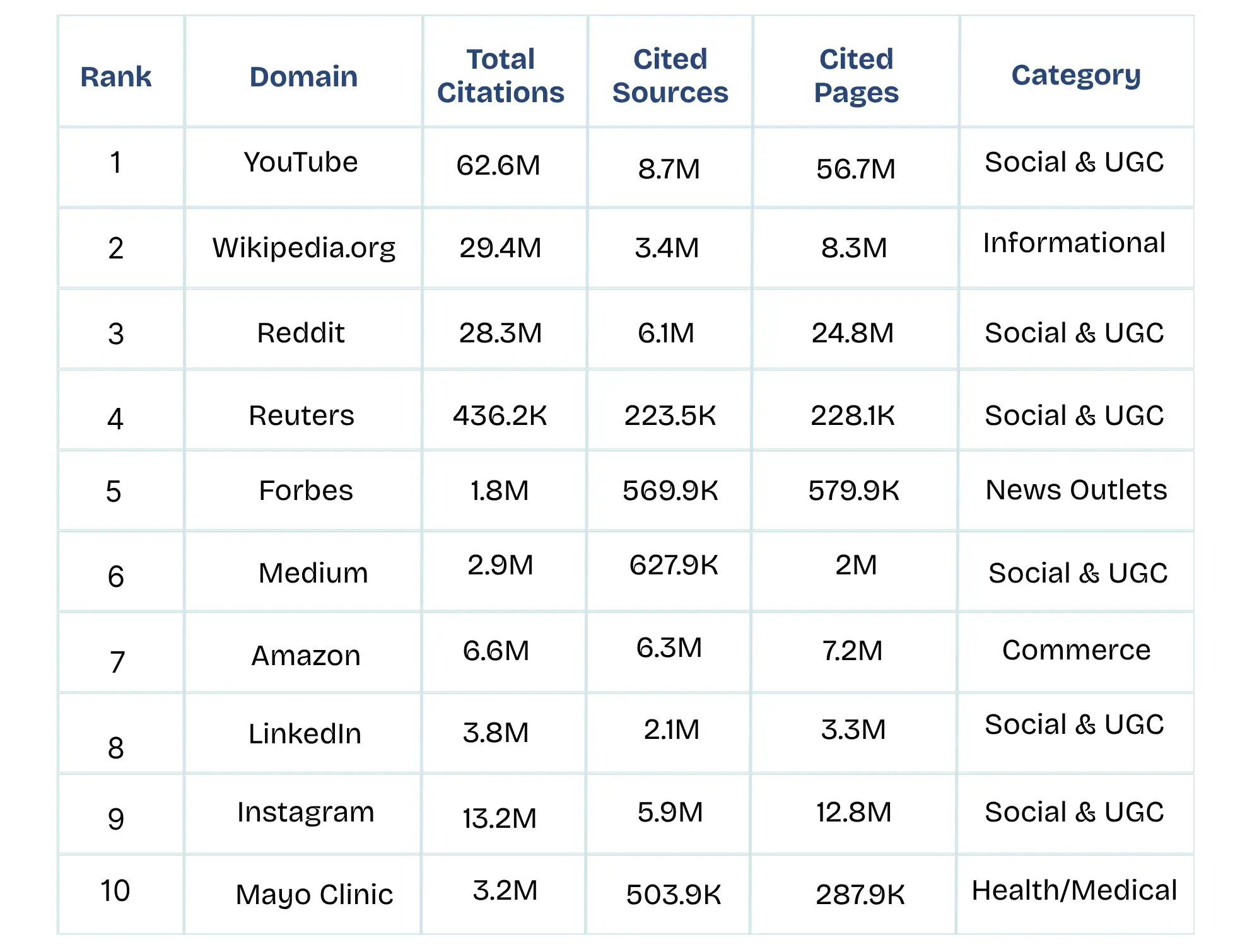
Based on studies we conducted with help of RankRabbit across ChatGPT, Perplexity, Claude and AI Overviews, the following domains consistently appear among the most cited:
1. YouTube
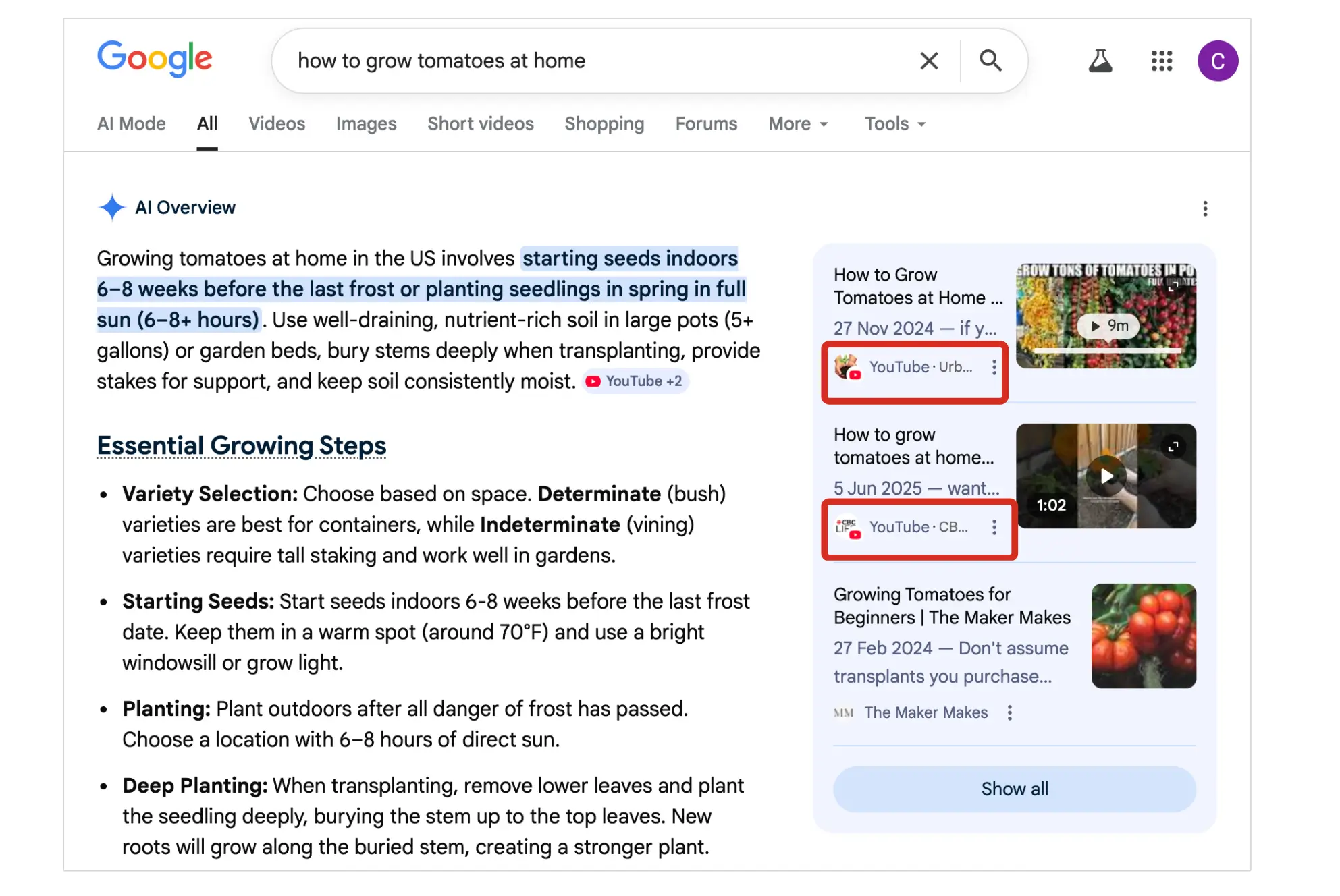
YouTube is the most-cited domain across AI search ecosystems by a significant margin, consistently outperforming every other content platform in citation frequency. With over 2.7 billion monthly active users globally (Statista, 2024), YouTube’s scale ensures continuous content ingestion into AI training and retrieval pipelines. Across Google AI Overviews alone, it appears in approximately 29–30% of generated responses, making it the single most referenced external source.
This dominance is structural.
YouTube functions as a multi-layered content system, where each video includes:
Titles and descriptions (primary semantic signals)
Transcripts and captions (fully indexable text layers)
Tags and categories (contextual classification)
Chapters and timestamps (granular segmentation)
This creates a dense metadata environment that allows AI systems like ChatGPT and Google Gemini to extract meaning with minimal ambiguity. However, citation placement reveals a more nuanced role.
YouTube most commonly appears in positions 6–10 within AI outputs, suggesting it functions as supporting multimodal validation rather than primary authority.
The strategic implication is significant: combining written content with a corresponding video creates dual citation opportunities—a structural advantage that text-only strategies cannot replicate.
YouTube also shows the strongest correlation with AI visibility (0.737) across platforms, making it the single most predictive factor of citation frequency.
2. Wikipedia
Wikipedia remains the core knowledge backbone of AI systems. Unlike YouTube, which operates as a reinforcement layer, Wikipedia functions as a primary grounding source. It hosts 60M+ articles globally (Wikimedia Foundation, 2024). Its content is frequently used to define entities, establish context, and anchor factual accuracy.
Its dominance is driven by:
Strict editorial guidelines
Neutral point-of-view policy
Dense internal linking (entity graph structure)
AI models rely heavily on Wikipedia for entity disambiguation and topic validation, particularly in early stages of answer construction. In many cases, Wikipedia is not always visibly cited—but it is implicitly embedded in model training and retrieval layers.
The implication is clear: visibility in AI search is strongly tied to entity presence within Wikipedia’s ecosystem, whether directly or through secondary references.
3. Reddit
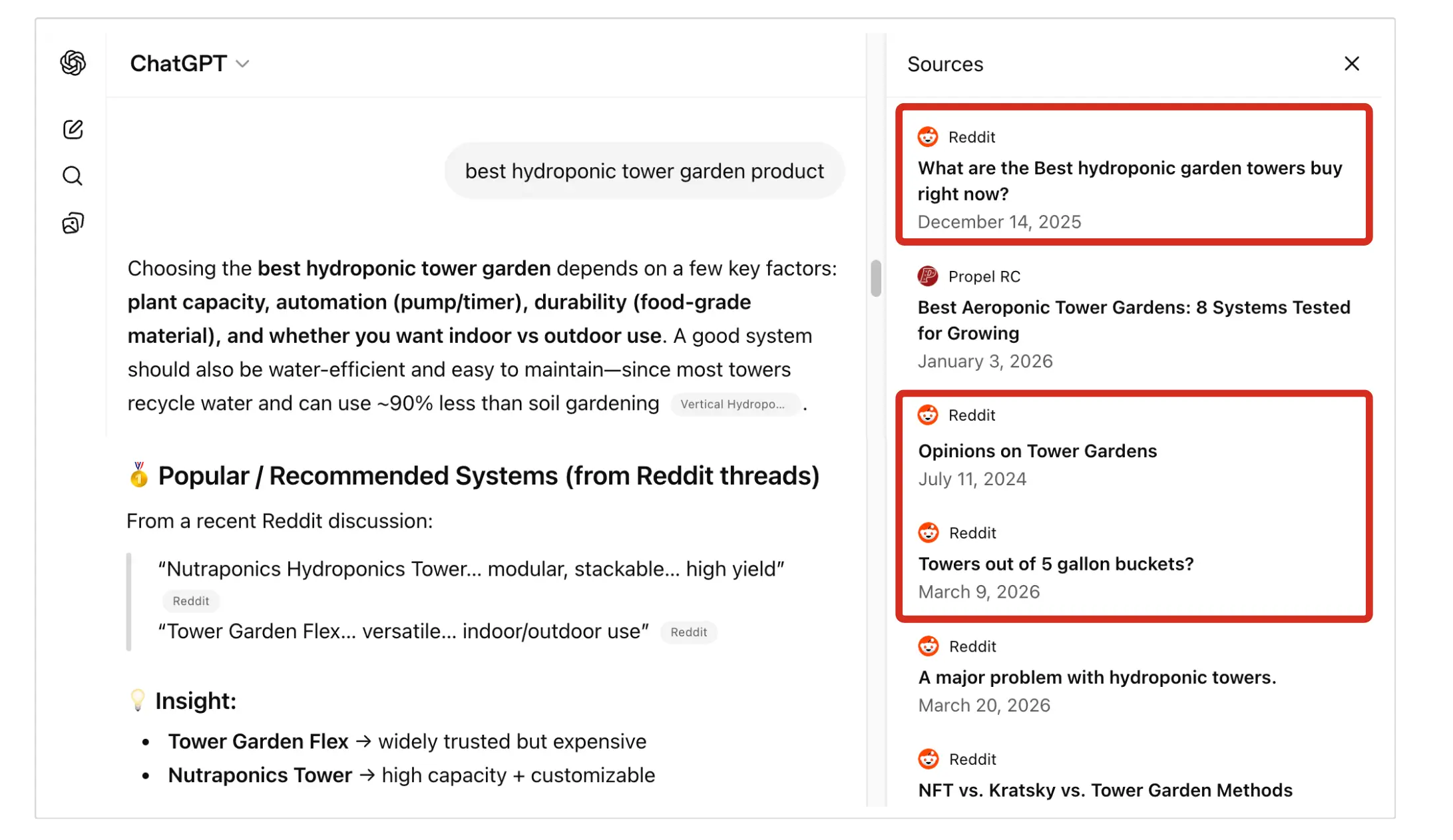
Reddit has emerged as the dominant source of experiential data across AI systems. It appears in ~18–22% of AI-generated responses for opinion-based and comparison queries (Statista).
The platform generates ~16 billion+ posts and comments annually, creating massive real-world data coverage (Besedo). While traditional SEO prioritized polished, authoritative content, AI models increasingly surface real-world opinions, discussions, and first-hand experiences—areas where Reddit excels.
Its strength lies in:
High-volume long-tail query coverage
Conversational, intent-aligned language
Authentic user-generated insights
Reddit is disproportionately cited in queries involving:
Product comparisons
Personal experiences
“Best” or “worth it” decisions
This reflects a broader shift: AI systems are optimizing for answer completeness, not just authority—blending expert content with human perspective.
4. Reuters
Reuters functions as a high-trust verification layer within AI outputs. It operates in 200+ locations globally with over 2,500+ journalists, producing thousands of verified news updates daily (ResearchGate).
In queries involving current events, finance, or global policy, AI systems prioritize sources with:
Verified reporting standards
Editorial rigor
Minimal bias signals
Reuters is frequently used to validate factual claims, particularly when multiple sources present conflicting information. Its role is less about volume and more about credibility weighting within the answer-generation process.
5. Forbes
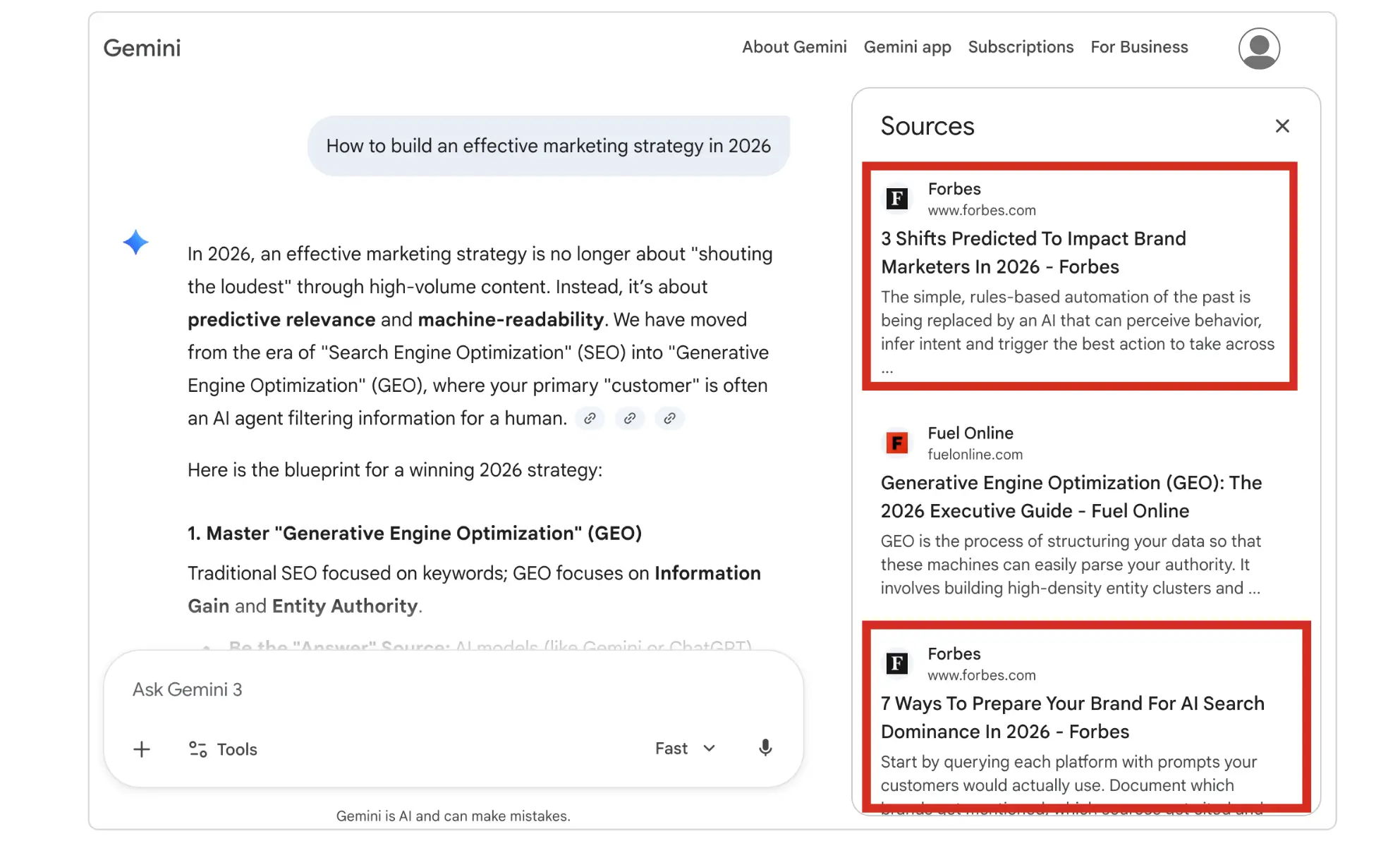
Forbes occupies a unique position at the intersection of authority and commercial relevance. Around 60–70% of Forbes content is contributor-based, enabling diverse expert opinions at scale (JournalismUK).
It is heavily cited in:
Business strategy queries
Marketing insights
Entrepreneurship topics
Its contributor-based model allows for a high volume of expert-driven content, which aligns well with AI systems seeking opinion-backed authority rather than purely informational text.
This highlights an important distinction: AI systems do not only value neutral sources—they also prioritize informed perspectives when context demands interpretation.
6. Medium
Medium consistently appears as a long-form explanatory layer in AI outputs. It hosts 150M+ monthly readers (Worldmetrics), with strong engagement on long-form content. Unlike Wikipedia (structured neutrality) or Reddit (UGC), Medium provides:
Deep dives
Narrative-driven explanations
Niche expertise
It performs particularly well in:
Technical topics
Personal frameworks
Case-study-driven queries
Its success indicates that AI systems favor depth and clarity over brevity, especially when answering complex or multi-step questions.
7. Amazon
Amazon dominates citations in transactional and product-intent queries. Over 1.5 billion+ customer reviews act as large-scale sentiment datasets (CMSwire).
Its advantage lies in:
Structured product data
Large-scale review signals
Consistent taxonomy across categories
AI systems frequently reference Amazon for:
Product comparisons
Feature breakdowns
Buyer decision support
Importantly, reviews act as aggregated sentiment datasets, allowing AI models to infer consensus rather than relying on single-source opinions.
8. LinkedIn
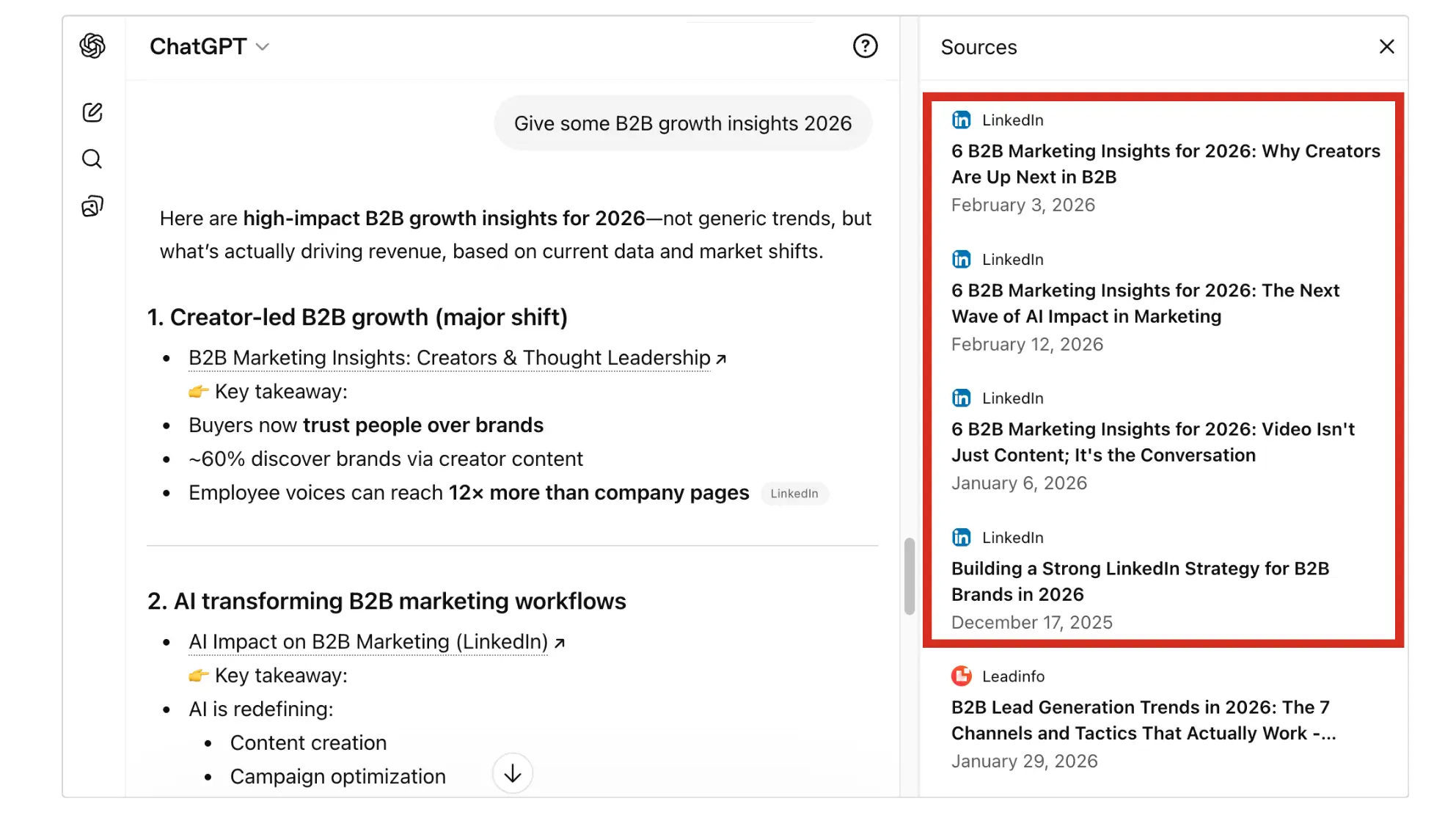
LinkedIn represents a new category: professional authority and real-world expertise at scale. It has 1 billion+ members globally, with 65M+ decision-makers on the platform (DemandSage)
It dominates queries such as:
“Best marketing strategies”
“B2B growth insights”
“Industry trends and leadership advice”
Its success is driven by:
Expert-led content and real profiles
High trust and credibility signals
Consistent thought leadership publishing
LinkedIn demonstrates that AI visibility can be built through people-driven authority and credible expertise, not just traditional website content.
9. Instagarm
Instagram appears less frequently than traditional sources, but its role is strategically important. The content engagement rates are ~3–5x higher than other social platforms, making it a strong signal for popularity (Hootsuite).
It contributes cultural and trend-based signals, particularly in:
Lifestyle queries
Influencer-related searches
Brand discovery
AI systems use Instagram to:
Validate popularity
Identify emerging trends
Contextualize brand presence
This reflects a broader shift toward real-time relevance signals beyond traditional web content.
10. Mayo Clinic
Mayo Clinic dominates citations in health and medical queries, where accuracy is critical. Publishes 10,000+ of evidence-based medical articles, all reviewed by clinical experts (Wikipedia) makes it best resource for health related queires.
Its authority is built on:
Medical expertise
Evidence-based content
Institutional trust
In high-risk categories (YMYL), AI systems prioritize sources like Mayo Clinic to minimize misinformation. This reinforces a key principle: in sensitive domains, authority is not optional—it is mandatory.
There Is No Universal “Top 10”
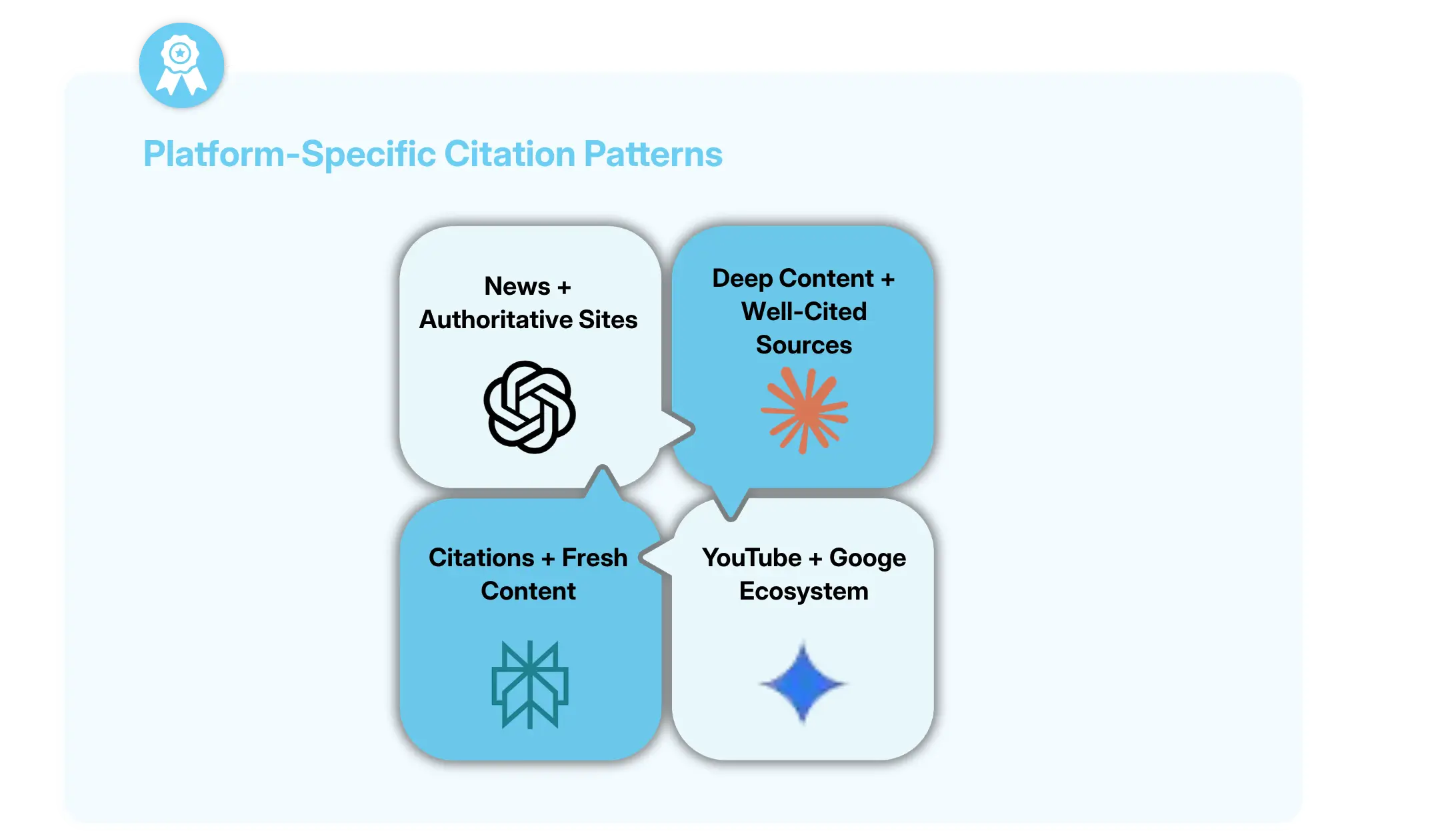
One of the most surprising findings: Only ~14% of top domains overlap across AI platforms. This means:
ChatGPT, Gemini, and Perplexity do not rely on the same sources
Each AI system has its own bias, training data, and retrieval layer
Why These Domains Keep Winning
1. Entity Authority > Keyword Rankings
The dominance of these domains is not accidental. It is the result of how AI systems are trained and how they evaluate information. At a fundamental level, large language models operate on entities rather than keywords.
Example:
“Apple” → Company entity
“iPhone 15” → Product entity
“Tim Cook” → Person entity
Domains that clearly define and connect entities dominate. This is one of the key reasons why Wikipedia performs so well. It doesn’t just provide information—it maps relationships between entities. Every page is part of a larger knowledge graph, which aligns seamlessly with how AI models process context.
2. Consensus Beats Self-Promotion
AI prefers:
Third-party reviews
Comparison articles
Aggregated opinions
Not:
Self-promotional landing pages
AI systems tend to favor information that is corroborated across multiple sources. A claim mentioned on several independent, authoritative platforms is far more likely to be included in an AI-generated answer than a statement that appears only on a brand’s own website.
3. Structured Content Wins
AI favors content that is:
Well-structured (H2s, FAQs, schema)
Easy to extract
Clearly segmented
Research shows that metadata, structured data, and semantic HTML strongly influence citations.
4. Freshness Is a Ranking Factor
Recently updated content is significantly more likely to be cited
Older pages gradually lose AI visibility
This reflects a shift toward real-time relevance, where outdated information is less likely to be trusted.
5. Multi-Format Content Dominates
Text alone is no longer enough.
Winning formats:
Video (YouTube)
Discussions (Reddit)
Expert articles (news/medical sites)
6. Brand Mentions Matter More Than Backlinks
Traditional SEO = backlinks
AI SEO = mentions across trusted sources
Even without ranking #1:
You can still be cited
If your brand appears across multiple authoritative sites
The Fragmentation of AI Citations
One of the most interesting findings from recent studies is that there is surprisingly little overlap between the sources cited by different AI systems. A domain that appears frequently in ChatGPT responses may not have the same visibility in Google AI Overviews or Perplexity.
This fragmentation suggests that each platform has its own retrieval mechanisms, training data, and ranking logic. For marketers and SEO professionals, this means that optimizing for a single platform is not enough. Visibility in the AI ecosystem requires a broader, more diversified approach.
It also reinforces the idea that AI search is not a monolithic system. Instead, it is a collection of distinct environments, each with its own rules and preferences. Understanding these nuances is essential for building a sustainable visibility strategy.
How Brands Can Adapt to AI Citation Behavior
Adapting to this new landscape requires a strategic approach that goes beyond traditional SEO tactics.
Build strong entity-level authority by clearly defining your brand, products, and expertise, and maintaining consistency across all platforms.
Focus on earning mentions on trusted platforms such as Reddit, Quora, and reputable news websites to strengthen credibility and increase citation chances.
Create easily extractable content by using concise explanations, structured formatting, and clear answers that AI systems can quickly understand and reference.
Move beyond just long-form blogs and produce well-structured, scannable content like guides, FAQs, and summaries that align with AI response formats.
Embrace multi-format content strategies, especially video, by publishing on platforms like YouTube to improve visibility in multimodal AI results.
Regularly update and refresh content to ensure accuracy, relevance, and higher chances of being cited in dynamic AI-generated responses.
Final Thoughts
The dominance of platforms like Wikipedia, YouTube, Reddit, and Reuters highlights a fundamental truth about AI-driven search: it is built on trust, structure, and consensus. These systems are not just retrieving information—they are evaluating it.
For businesses and marketers, this means that success in the AI era requires a broader, more holistic approach. It is no longer enough to optimize for search engines. You must optimize for the entire information ecosystem.
Because in the age of AI, visibility is not about being ranked.
It is about being remembered, trusted, and ultimately—cited.
FAQs
How do AI platforms select a citation?

Mostly entity authority, structure, and consensus. AI systems go for content that clearly defines entities and how they connect, gets backed up across multiple independent sources instead of just showing up on one brand's own page, and is formatted so it's easy to pull from, clear headings, FAQs, schema, and that kind of thing. Freshness plays a part too, pages that sit unupdated for too long start losing citation visibility over time.
Do SEO top-ranking pages get cited by AI tools?
Why is YouTube the most-cited domain across AI platforms?
Why don't ChatGPT, Gemini, and Perplexity cite the same sources?
How can a brand improve its chances of being cited by AI?
The way people search is undergoing a fundamental transformation. Traditional search engines are no longer the only gateway to information. Platforms like ChatGPT, Perplexity AI, Google Gemini, Google AI Overviews, and Claude are rapidly becoming primary interfaces for discovery, research, and decision-making.
Unlike traditional search engines that return a list of links, these AI systems synthesize answers. They don’t just show results—they decide which sources are credible enough to include in a response. This shift has introduced a new kind of competition: not just ranking on search engines, but being cited by AI.
To understand what drives visibility in this new layer, we analyzed citation patterns using data from RankRabbit.
Understanding these patterns is critical because in the AI-driven ecosystem, visibility is no longer about being ranked—it’s about being referenced.
The 10 Most Cited Domains Across AI Assistants
Based on studies we conducted with help of RankRabbit across ChatGPT, Perplexity, Claude and AI Overviews, the following domains consistently appear among the most cited:
1. YouTube
YouTube is the most-cited domain across AI search ecosystems by a significant margin, consistently outperforming every other content platform in citation frequency. With over 2.7 billion monthly active users globally (Statista, 2024), YouTube’s scale ensures continuous content ingestion into AI training and retrieval pipelines. Across Google AI Overviews alone, it appears in approximately 29–30% of generated responses, making it the single most referenced external source.
This dominance is structural.
YouTube functions as a multi-layered content system, where each video includes:
Titles and descriptions (primary semantic signals)
Transcripts and captions (fully indexable text layers)
Tags and categories (contextual classification)
Chapters and timestamps (granular segmentation)
This creates a dense metadata environment that allows AI systems like ChatGPT and Google Gemini to extract meaning with minimal ambiguity. However, citation placement reveals a more nuanced role.
YouTube most commonly appears in positions 6–10 within AI outputs, suggesting it functions as supporting multimodal validation rather than primary authority.
The strategic implication is significant: combining written content with a corresponding video creates dual citation opportunities—a structural advantage that text-only strategies cannot replicate.
YouTube also shows the strongest correlation with AI visibility (0.737) across platforms, making it the single most predictive factor of citation frequency.
2. Wikipedia
Wikipedia remains the core knowledge backbone of AI systems. Unlike YouTube, which operates as a reinforcement layer, Wikipedia functions as a primary grounding source. It hosts 60M+ articles globally (Wikimedia Foundation, 2024). Its content is frequently used to define entities, establish context, and anchor factual accuracy.
Its dominance is driven by:
Strict editorial guidelines
Neutral point-of-view policy
Dense internal linking (entity graph structure)
AI models rely heavily on Wikipedia for entity disambiguation and topic validation, particularly in early stages of answer construction. In many cases, Wikipedia is not always visibly cited—but it is implicitly embedded in model training and retrieval layers.
The implication is clear: visibility in AI search is strongly tied to entity presence within Wikipedia’s ecosystem, whether directly or through secondary references.
3. Reddit
Reddit has emerged as the dominant source of experiential data across AI systems. It appears in ~18–22% of AI-generated responses for opinion-based and comparison queries (Statista).
The platform generates ~16 billion+ posts and comments annually, creating massive real-world data coverage (Besedo). While traditional SEO prioritized polished, authoritative content, AI models increasingly surface real-world opinions, discussions, and first-hand experiences—areas where Reddit excels.
Its strength lies in:
High-volume long-tail query coverage
Conversational, intent-aligned language
Authentic user-generated insights
Reddit is disproportionately cited in queries involving:
Product comparisons
Personal experiences
“Best” or “worth it” decisions
This reflects a broader shift: AI systems are optimizing for answer completeness, not just authority—blending expert content with human perspective.
4. Reuters
Reuters functions as a high-trust verification layer within AI outputs. It operates in 200+ locations globally with over 2,500+ journalists, producing thousands of verified news updates daily (ResearchGate).
In queries involving current events, finance, or global policy, AI systems prioritize sources with:
Verified reporting standards
Editorial rigor
Minimal bias signals
Reuters is frequently used to validate factual claims, particularly when multiple sources present conflicting information. Its role is less about volume and more about credibility weighting within the answer-generation process.
5. Forbes
Forbes occupies a unique position at the intersection of authority and commercial relevance. Around 60–70% of Forbes content is contributor-based, enabling diverse expert opinions at scale (JournalismUK).
It is heavily cited in:
Business strategy queries
Marketing insights
Entrepreneurship topics
Its contributor-based model allows for a high volume of expert-driven content, which aligns well with AI systems seeking opinion-backed authority rather than purely informational text.
This highlights an important distinction: AI systems do not only value neutral sources—they also prioritize informed perspectives when context demands interpretation.
6. Medium
Medium consistently appears as a long-form explanatory layer in AI outputs. It hosts 150M+ monthly readers (Worldmetrics), with strong engagement on long-form content. Unlike Wikipedia (structured neutrality) or Reddit (UGC), Medium provides:
Deep dives
Narrative-driven explanations
Niche expertise
It performs particularly well in:
Technical topics
Personal frameworks
Case-study-driven queries
Its success indicates that AI systems favor depth and clarity over brevity, especially when answering complex or multi-step questions.
7. Amazon
Amazon dominates citations in transactional and product-intent queries. Over 1.5 billion+ customer reviews act as large-scale sentiment datasets (CMSwire).
Its advantage lies in:
Structured product data
Large-scale review signals
Consistent taxonomy across categories
AI systems frequently reference Amazon for:
Product comparisons
Feature breakdowns
Buyer decision support
Importantly, reviews act as aggregated sentiment datasets, allowing AI models to infer consensus rather than relying on single-source opinions.
8. LinkedIn
LinkedIn represents a new category: professional authority and real-world expertise at scale. It has 1 billion+ members globally, with 65M+ decision-makers on the platform (DemandSage)
It dominates queries such as:
“Best marketing strategies”
“B2B growth insights”
“Industry trends and leadership advice”
Its success is driven by:
Expert-led content and real profiles
High trust and credibility signals
Consistent thought leadership publishing
LinkedIn demonstrates that AI visibility can be built through people-driven authority and credible expertise, not just traditional website content.
9. Instagarm
Instagram appears less frequently than traditional sources, but its role is strategically important. The content engagement rates are ~3–5x higher than other social platforms, making it a strong signal for popularity (Hootsuite).
It contributes cultural and trend-based signals, particularly in:
Lifestyle queries
Influencer-related searches
Brand discovery
AI systems use Instagram to:
Validate popularity
Identify emerging trends
Contextualize brand presence
This reflects a broader shift toward real-time relevance signals beyond traditional web content.
10. Mayo Clinic
Mayo Clinic dominates citations in health and medical queries, where accuracy is critical. Publishes 10,000+ of evidence-based medical articles, all reviewed by clinical experts (Wikipedia) makes it best resource for health related queires.
Its authority is built on:
Medical expertise
Evidence-based content
Institutional trust
In high-risk categories (YMYL), AI systems prioritize sources like Mayo Clinic to minimize misinformation. This reinforces a key principle: in sensitive domains, authority is not optional—it is mandatory.
There Is No Universal “Top 10”
One of the most surprising findings: Only ~14% of top domains overlap across AI platforms. This means:
ChatGPT, Gemini, and Perplexity do not rely on the same sources
Each AI system has its own bias, training data, and retrieval layer
Why These Domains Keep Winning
1. Entity Authority > Keyword Rankings
The dominance of these domains is not accidental. It is the result of how AI systems are trained and how they evaluate information. At a fundamental level, large language models operate on entities rather than keywords.
Example:
“Apple” → Company entity
“iPhone 15” → Product entity
“Tim Cook” → Person entity
Domains that clearly define and connect entities dominate. This is one of the key reasons why Wikipedia performs so well. It doesn’t just provide information—it maps relationships between entities. Every page is part of a larger knowledge graph, which aligns seamlessly with how AI models process context.
2. Consensus Beats Self-Promotion
AI prefers:
Third-party reviews
Comparison articles
Aggregated opinions
Not:
Self-promotional landing pages
AI systems tend to favor information that is corroborated across multiple sources. A claim mentioned on several independent, authoritative platforms is far more likely to be included in an AI-generated answer than a statement that appears only on a brand’s own website.
3. Structured Content Wins
AI favors content that is:
Well-structured (H2s, FAQs, schema)
Easy to extract
Clearly segmented
Research shows that metadata, structured data, and semantic HTML strongly influence citations.
4. Freshness Is a Ranking Factor
Recently updated content is significantly more likely to be cited
Older pages gradually lose AI visibility
This reflects a shift toward real-time relevance, where outdated information is less likely to be trusted.
5. Multi-Format Content Dominates
Text alone is no longer enough.
Winning formats:
Video (YouTube)
Discussions (Reddit)
Expert articles (news/medical sites)
6. Brand Mentions Matter More Than Backlinks
Traditional SEO = backlinks
AI SEO = mentions across trusted sources
Even without ranking #1:
You can still be cited
If your brand appears across multiple authoritative sites
The Fragmentation of AI Citations
One of the most interesting findings from recent studies is that there is surprisingly little overlap between the sources cited by different AI systems. A domain that appears frequently in ChatGPT responses may not have the same visibility in Google AI Overviews or Perplexity.
This fragmentation suggests that each platform has its own retrieval mechanisms, training data, and ranking logic. For marketers and SEO professionals, this means that optimizing for a single platform is not enough. Visibility in the AI ecosystem requires a broader, more diversified approach.
It also reinforces the idea that AI search is not a monolithic system. Instead, it is a collection of distinct environments, each with its own rules and preferences. Understanding these nuances is essential for building a sustainable visibility strategy.
How Brands Can Adapt to AI Citation Behavior
Adapting to this new landscape requires a strategic approach that goes beyond traditional SEO tactics.
Build strong entity-level authority by clearly defining your brand, products, and expertise, and maintaining consistency across all platforms.
Focus on earning mentions on trusted platforms such as Reddit, Quora, and reputable news websites to strengthen credibility and increase citation chances.
Create easily extractable content by using concise explanations, structured formatting, and clear answers that AI systems can quickly understand and reference.
Move beyond just long-form blogs and produce well-structured, scannable content like guides, FAQs, and summaries that align with AI response formats.
Embrace multi-format content strategies, especially video, by publishing on platforms like YouTube to improve visibility in multimodal AI results.
Regularly update and refresh content to ensure accuracy, relevance, and higher chances of being cited in dynamic AI-generated responses.
Final Thoughts
The dominance of platforms like Wikipedia, YouTube, Reddit, and Reuters highlights a fundamental truth about AI-driven search: it is built on trust, structure, and consensus. These systems are not just retrieving information—they are evaluating it.
For businesses and marketers, this means that success in the AI era requires a broader, more holistic approach. It is no longer enough to optimize for search engines. You must optimize for the entire information ecosystem.
Because in the age of AI, visibility is not about being ranked.
It is about being remembered, trusted, and ultimately—cited.
FAQs
How do AI platforms select a citation?
Mostly entity authority, structure, and consensus. AI systems go for content that clearly defines entities and how they connect, gets backed up across multiple independent sources instead of just showing up on one brand's own page, and is formatted so it's easy to pull from, clear headings, FAQs, schema, and that kind of thing. Freshness plays a part too, pages that sit unupdated for too long start losing citation visibility over time.
Do SEO top-ranking pages get cited by AI tools?
Why is YouTube the most-cited domain across AI platforms?
Why don't ChatGPT, Gemini, and Perplexity cite the same sources?
How can a brand improve its chances of being cited by AI?



Summarize with AI



Want to be seen everywhere?
Get a free AI-search audit Today!



4.9/5 Ratings!


Don’t miss our revenue growth tips!
Get expert marketing tips—straight to your inbox, like thousands of happy clients.
Don’t miss our revenue growth tips!
Get expert marketing tips—straight to your inbox, like thousands of happy clients.
Don’t miss our revenue growth tips!
Don’t miss our revenue growth tips!
Get expert marketing tips—straight to your inbox, like thousands of happy clients.
Relevant Blogs on Generative AI SEO
Relevant Blogs on Generative AI SEO
Unlock data-driven insights in AI-powered SEO—explore our featured blogs and skyrocket your revenue before your competitors do.
Unlock data-driven insights in AI-powered SEO—explore our featured blogs and skyrocket your revenue before your competitors do.

GEO
Aug 25, 2026
5 Min Read
What Is Answer Engine Optimization (AEO) and How Does It Work?
GEO
Aug 25, 2026
5 Min Read
What Is Answer Engine Optimization (AEO) and How Does It Work?
GEO
Aug 25, 2026
5 Min Read
What Is Answer Engine Optimization (AEO) and How Does It Work?

GEO
Aug 24, 2026
12 Min Read
7 Best AI Visibility Tracking Tools for Agencies and Businesses
GEO
Aug 24, 2026
12 Min Read
7 Best AI Visibility Tracking Tools for Agencies and Businesses
GEO
Aug 24, 2026
12 Min Read
7 Best AI Visibility Tracking Tools for Agencies and Businesses

GEO
Aug 12, 2026
25 Min Read
Top 10 Tips to Make Your Website Rank in Al
GEO
Aug 12, 2026
25 Min Read
Top 10 Tips to Make Your Website Rank in Al
GEO
Aug 12, 2026
25 Min Read
Top 10 Tips to Make Your Website Rank in Al





























Ready to speak with an expert?
Data-Driven Marketing Agency That Elevates ROI
1100+
Websites Designed & Optimized to Convert
$280M+
Client Revenue Driven & Growing Strong
Discover how to skyrocket
your revenue today!
Trusted by 1000+ Owners!
Ready to speak with an expert?
Data-Driven Marketing Agency That Elevates ROI
1100+
Websites Designed & Optimized to Convert
$280M+
Client Revenue Driven & Growing Strong
Discover how to skyrocket
your revenue today!
Trusted by 1000+ Owners!
Want to skyrocket revenue?
4.9/5 Ratings!
Ready to speak with an expert?
Data-Driven Marketing Agency That Elevates ROI
1100+
Websites Designed & Optimized to Convert
$280M+
Client Revenue Driven & Growing Strong
Want to skyrocket
revenue?
Trusted by 1000+ Owners!
Call
Meet